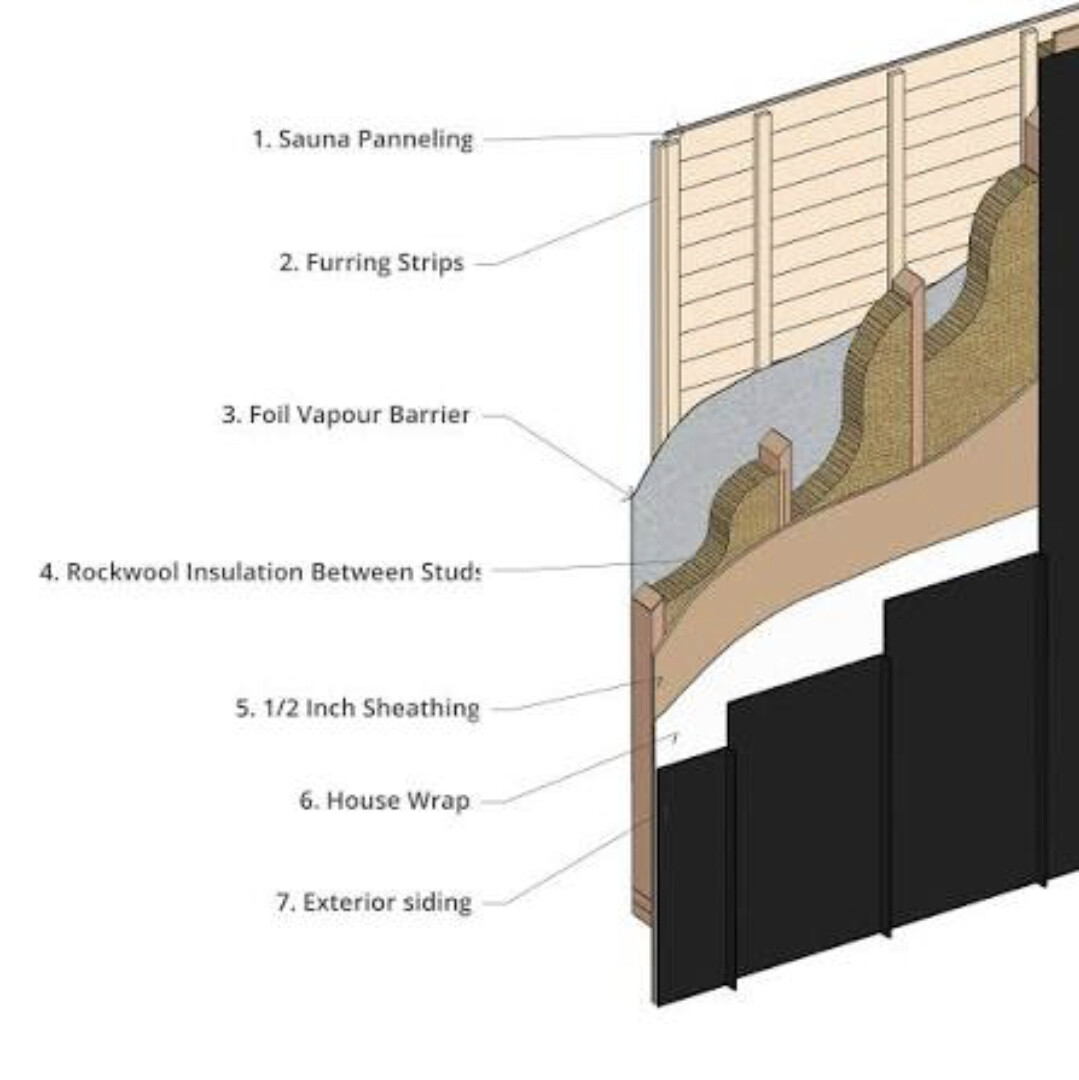
I’ve recently noted a trend in some UK-based sauna builds where the internal structure—on the hot side of the main insulation—is lined with OSB or plywood before the foil and cladding are applied. As a specialist in sauna physics, I believe it’s important to address the chemical and thermal risks this method introduces.
1. Decomposition vs. Off-Gassing: A Critical Distinction
A common defense for using OSB is that it requires temperatures of 200°C+ to “decompose” or char. This is a misunderstanding of the science. We are not concerned with Pyrolysis (burning); we are concerned with Volatilization (off-gassing).
To use an analogy: water off-gasses (boils) at 100°C, but it only decomposes into hydrogen and oxygen at 2000°C. We are worried about the “boiling point” of the industrial glues and resins, not the “burning point” of the wood.
2. The Exponential Nature of Heat and VOCs
Chemical emissions are not linear; they increase exponentially with temperature. Research shows that raising the temperature of engineered boards by even 15°C can more than double the release of Volatile Organic Compounds (VOCs). In a sauna environment where ceiling temperatures frequently hit 100°C+, the OSB is essentially being “baked,” forcing chemicals into the air.
3. The “Heat Bridge” Flaw
Some builders claim the OSB stays cool due to the internal air gap. This ignores basic conductive heat transfer. To fix the battens and cladding, thousands of metal staples or nails are fired through the foil directly into the OSB.
These metal fixings act as heat bridges, conducting high temperatures from the hot cladding directly into the OSB, bypassing the air gap entirely. The OSB heats up regardless of the foil.
4. The “Formaldehyde-Free” Trap: Isocyanates (pMDI)
Modern “formaldehyde-free” OSB often uses pMDI (isocyanate) resins. Isocyanates are a primary cause of occupational asthma and are highly toxic when inhaled.
Public safety bodies, such as SafeWork, explicitly warn that heating isocyanate-containing materials is likely to release these toxins into the atmosphere. Thermal breakdown can begin at temperatures as low as 100°C—a standard Tuesday night for a sauna ceiling.
5. The Barrier Problem
A foil vapour barrier is designed to stop water vapour; it is not a gas-proof hermetic seal. When the OSB off-gasses behind the foil, the resulting pressure forces toxic gases through every staple perforation and seam into the cabin air.
The Burden of Proof
There is zero structural or thermal benefit to placing engineered boards on the hot side of a build. It introduces an unquantified chemical risk to the bather.
If a builder suggests this method, the simple question to ask is: “Can you provide the manufacturer’s data sheet certifying this OSB as safe for repeated heating to 100°C in an enclosed, inhabited room?”
The correct, safe method remains:
Main Insulation Layer
Continuous Sauna Foil Vapour Barrier (All seams taped)
Vertical Air Gap (Battens)
Untreated Internal Timber Cladding (Spruce, Cedar, Aspen, etc.)
To assist the community, I have produced a Builder’s Material Audit Checklist (detailed on a separate post) to help identify and avoid these risks.
Lewis Jenkinson
Founding Technical Officer - British Sauna Society, Director of Heat Construction